


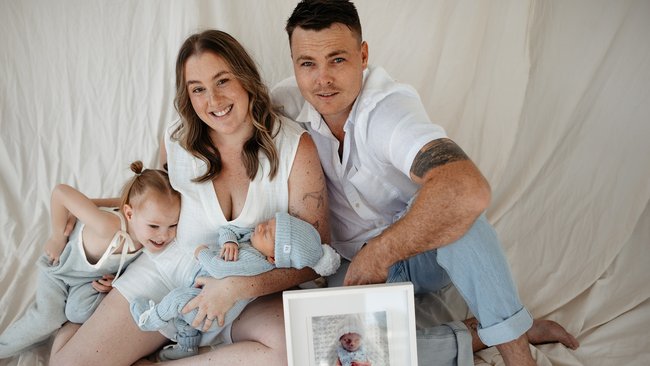
The first few weeks of motherhood after often painted as joyful, filled with newborn cuddles and celebration.
But for many women, they can also be the most vulnerable.
WATCH THE VIDEO ABOVE: Postnatal depression risk peaks two weeks after birth
Know the news with the 7NEWS app: Download today
In the largest mental health study of its kind, the University of Queensland has discovered major depression has the highest prevalence two weeks after giving birth.
Brittany Matsen’s journey into motherhood has been marked by heartbreak and resilience.
“I have had three babies. Our eldest, Lennox, he passed away,” she told 7NEWS.
“So I experienced PNDA (Perinatal Depression and Anxiety) through that journey mixed with grief.
“And then we went on to have our second child, Waverly, and she was born at 26 weeks. So a lot of anxiety mixed in with that.”
Last year, she had her third child and faced complications, which resulted in a two week stay in hospital.

Despite everything she already endured and being proactive in seeking support, Matsen says postnatal depression still took hold.
“Knowing what I had been through I felt like I was knowledgeable, well supported. But still it didn’t I guess protect me from what came afterwards.
“So yeah, again it was another really hard journey.”
Honorary Associate Professor Alize Ferrari, from the University of Queensland, says major depression in women and girls peaks two weeks after giving birth.
“Globally, major depression impacts about 4.3 per cent of women and girls in the broader population, but we found the prevalence was 6.2 per cent for women and girls during pregnancy and 6.8 per cent during the 12 months after childbirth,” Ferrari said.
Researchers used data from 780 studies, collected from more than 2 million women and girls across 90 countries.
Experts say the results highlight the need for including early screening and intervention for depression during the entire peripartum period.
“Depression is common. It’s disabling and needs to be looked at,” Ferrari said.

In Australia, postnatal depression affects around one in seven women.
But advocates, including Alecia Staines from the Maternity Consumer Network, warn not everyone is getting the help they need.
“Some of these women who should be getting support are possibly slipping through the cracks,” she said.
She also points to broader issues, like a “fragmented maternity care” and birth trauma, which can increase the risk of PNDA.
“One in three women are experiencing birth trauma and most of that is preventable,” she said.
Support is available through GPs and organisations like the Gidget Foundation Australia and Centre of Perinatal Excellence.

Perinatal Anxiety & Depression Australia (PANDA) also offers a free national helpline for families.
“There is a growing awareness, but we want people to be able to reach out early,” clinical psychologist and PANDA CEO Julie Borninkhof said.
“We know in the early stages, having just had a baby, you’re transitioning and changing identities.
“We would encourage people to have a chat with their local health providers and those that are supporting them at that time.”
For Matsen, getting support through the Gidget Foundation made a profound difference.
“I still stayed connected with the Gidget Foundation and continued to seek support through them and then afterwards as well.”


